

Compared with traditional liquid lithium-ion batteries, condensed matter battery technology has significant advantages in safety, performance, cost-effectiveness and application scenarios. It is especially suitable for occasions with extremely high safety standards, such as power stations, fossil factories, etc. . At the same time, the condensed matter battery production line is highly compatible with the existing liquid battery production line, reducing the cost of industrial upgrades. It has wide application prospects in high-energy demand fields such as electric vehicles, drones, and intelligent robots, and is an important force in promoting the development of the lithium battery industry.
Solid-state batteries: the next generation of battery products
In the global dual-carbon context, the penetration rate of new energy vehicles, especially electric vehicles, is rapidly increasing, and as the "heart" that powers electric vehicles, lithium batteries have long been known to everyone. However, as application scenarios gradually upgrade, the industry has put forward higher requirements for battery performance and safety.
In terms of performance, the current energy density of lithium batteries is still not enough to support the long battery life of electric vehicles, causing car owners to need to charge frequently, seriously affecting the efficiency of electric vehicles; and in terms of safety, the electrolyte of lithium batteries Contains organic solvents, whose highly volatile and flammable characteristics make current lithium batteries certain safety hazards.
In view of the current shortcomings of lithium batteries in the two major areas of performance and safety, the industry is actively developing new battery products, and all-solid-state batteries are widely considered to be the most promising next-generation lithium battery products.
The so-called all-solid-state battery completely replaces the liquid electrolyte in traditional lithium batteries with a solid electrolyte. The system no longer contains liquid components, and no separator is needed to block the positive and negative electrodes.
Compared with traditional liquid lithium batteries, all-solid-state batteries can be adapted to higher-performance positive and negative electrodes on the basis of improved safety, thereby achieving higher energy density, longer service life and faster speed charging speed, greatly improving battery performance. These advantages enable all-solid-state batteries to perform well in a variety of application scenarios, and solid-state batteries are an inevitable trend.
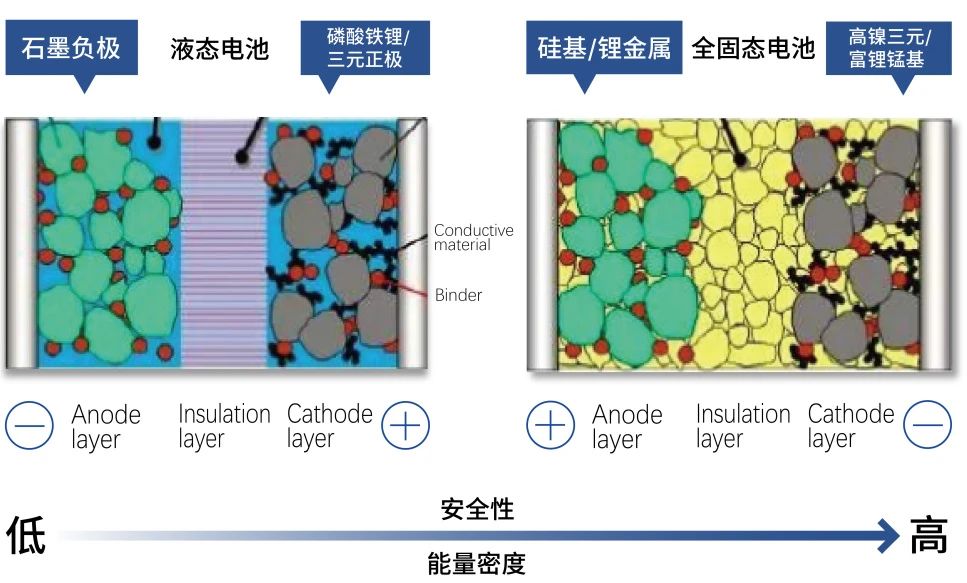
However, at this stage, it is difficult to realize all-solid-state battery technology, and there are still many difficulties to be overcome at the technical and industrial levels: the positive and negative electrode plates and the solid electrolyte cannot have perfect contact like a liquid. The interface resistance is large; in addition, all-solid-state batteries also have problems such as high raw material production costs, complex processes, and low yield rates.
Although many domestic and foreign leading battery manufacturers have made plans in the field of all-solid-state batteries, there is still a long way to go before their comprehensive promotion and application. For this reason, semi-solid-state batteries, as a transitional product, have received widespread attention in the current market.
Semi-solid batteries: transitional solution
●Basic concepts
Semi-solid battery is a transitional product in the development process from traditional liquid lithium-ion battery to solid-state battery, mainly in the form of solid-liquid mixture. Recent information about solid-state batteries has attracted widespread attention in the market, but according to strict definitions, the currently released products do not fall into the category of solid-state batteries, but are traditional lithium-ion batteries. Semi-solid-state batteries with improved materials.
Specifically, semi-solid batteries still retain the structure of traditional lithium batteries (positive and negative electrodes, electrolytes, separators), and have the same structure as traditional liquid lithium batteries. A certain amount of solid electrolyte is added to the battery, so that there are both liquid electrolyte and solid electrolyte inside the battery. In terms of performance and safety, semi-solid batteries have a slight improvement compared to liquid batteries, but they still contain more free-flowing flammable liquids in their structures.
● Challenge
At present, some semi-solid battery products have been trial-installed on vehicles, but there are also some problems, such as short battery cycle life, low charge and discharge rates, high production costs, complex processes, low yields, and many equipment changes. Therefore, the industry needs a more comprehensive and cost-effective solution.
Condensed Matter Batteries: Innovation and Improvement
● Basic concepts
In view of the current pain points in the industry, condensed matter battery products emerged at the historic moment. Condensed matter batteries use a special process to convert the flowing electrolyte into a gel electrolyte. The entire electrolyte is in a gel state, which does not affect the free flow of lithium ions and greatly reduces the free electrolyte inside the battery.

● Unique Advantages
1. High security:
Condensed matter batteries use gelling technology to effectively lock in flammable substances inside the battery, greatly reducing the risk of combustion. This innovative electrolyte design ensures that the battery remains stable and will not burn even under extreme conditions. The battery puncture test results showed that the fully charged battery cells maintained their integrity well throughout the entire test process and did not rupture, smoke or catch fire. The high safety of condensed matter batteries provides a more reliable guarantee for battery applications.

2. Excellent performance:
Condensed matter batteries use a special electrolyte addition process to ensure that the ion channel function of the electrolyte is not damaged during the gelation process, and the conductive performance is not inferior to that of liquid batteries. This technological optimization makes condensed matter batteries perform particularly well in high-rate usage scenarios, enabling rapid charging and discharging at high voltages, meeting the high demand for instant battery output power in emerging application scenarios.
In addition, the gelled electrolyte has excellent liquid retention and can effectively prevent leakage even under strong pressure. This not only protects the internal structure of the battery, but also significantly extends the service life of the battery.
In terms of energy density, the innovative gel electrolyte can be matched with higher-performance positive and negative electrode materials to further enhance the energy density of the battery. This progress enables application products equipped with condensed matter batteries to achieve longer battery life and larger storage capacity. The products are cost-effective and bring a better user experience.

3. Significant cost-effectiveness:
Condensed matter batteries adopt a process of in vitro polymerization and then assembly. The process is simple and the production yield rate is high. At the same time, the condensed matter battery production line has high compatibility with the existing liquid battery production line, which means Therefore, when carrying out technology upgrades and transformations, the required line modification costs are relatively low. This high compatibility not only reduces investment in industrial upgrading, but also facilitates the smooth transition of existing production lines, further reducing the operating costs of battery companies.
4. Wide range of application scenarios:
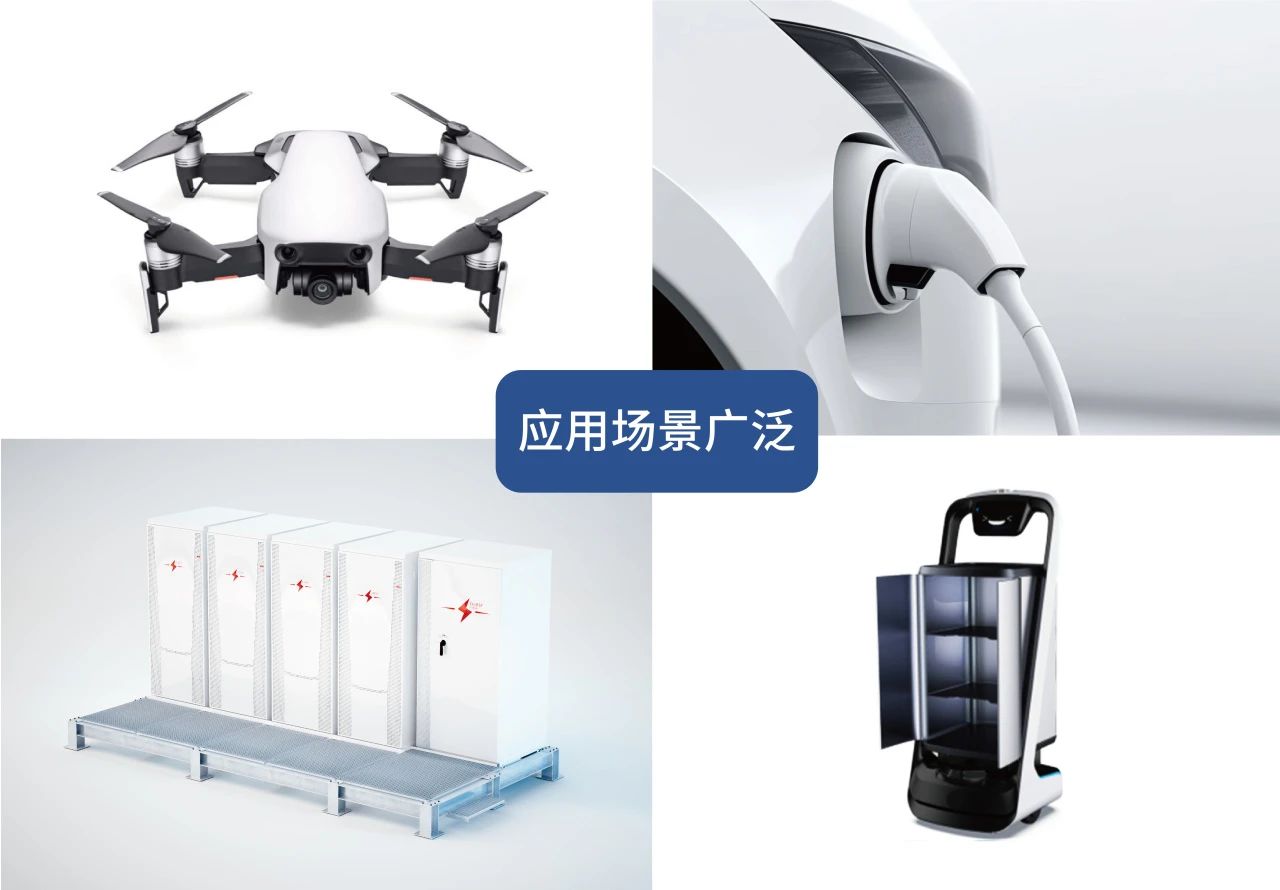
The high safety of condensed matter batteries is the key to their success in many application fields, especially for those occasions that have extremely high requirements for safety standards, such as power stations, fossil plants, natural gas pipelines, etc. Condensed matter batteries can Mounted on drones or robots, it provides customers with reliable intelligent inspection solutions to ensure the safe operation of these critical infrastructures.
At the same time, the high energy density and excellent charge and discharge rate of condensed matter batteries make them suitable for new energy vehicles, electric motorcycles, drones, intelligent robots, power tools, and emerging electric vertical takeoff and landing aircraft (eVTOL), etc. Ideal for applications with high energy demands. These application scenarios have extremely strict requirements on battery performance, and condensed matter batteries can provide the necessary power support while maintaining high efficiency and stability.
For home and portable energy storage products, it is necessary to not only ensure performance, but also consider economy and long-term reliability. Condensed matter batteries meet the above needs with their durability and cost-effectiveness, providing users with efficient and economical energy storage solutions.
● Product comparison
Compared with traditional liquid lithium-ion batteries, condensed matter batteries not only have higher energy density, but are also superior in safety, making them ideal for various applications such as electric vehicles, energy storage, and drones. Ideal for application scenarios.
Compared with solid-liquid hybrid semi-solid batteries that have been launched on the market, condensed matter batteries have a series of significant advantages, including but not limited to the ability to support high-rate rapid charge and discharge, long cycle life, and the ability to be used in production lines High adaptability, high yield and low production cost.
Condensed matter batteries have made innovations and breakthroughs based on semi-solid battery technology and are an important driving force for the further development of the lithium battery industry.
● Conclusion
With the increasingly strong demand for batteries, all-solid-state batteries have the two major advantages of high safety and high performance. They are recognized as the next generation of new energy solutions in the industry. Solid-state batteries have become an inevitable trend.
As a transitional product before solid-state batteries are launched, semi-solid batteries still have problems in battery life, charging speed, production cost and other aspects, and their impact on the entire industry chain is limited.
In contrast, condensed matter batteries have achieved simultaneous improvements in performance and safety, which can meet the current urgent demand for battery safety in the new energy market, help upgrade existing market products, and boost The ultra-long battery life and fast charging of new energy vehicles, drones and other products tap new potential in the lithium battery downstream market, thus providing new impetus for the continued growth and scale expansion of the lithium battery industry.


